
A hawk’s education
Klaas Knot - a policy profile
By Tim G. Jones - London, 10 March 2026
Feel free to republish this profile but cite 242econ.news and Tim G. Jones
By signalling her intention to leave the European Central Bank a year early, Christine Lagarde has fired the starting pistol on the race to succeed her as president of the powerful 28-year-old institution.
Pablo Hernández de Cos and Klaas Knot, who served as the Spanish and Dutch representatives on the ECB’s governing council until 2024 and 2025 respectively, have rapidly emerged as frontrunners. Germany is again teasing its claim to the ECB’s presidency as well as its Frankfurt headquarters and floating Joachim Nagel and Isabel Schnabel1 as potential nominees. But both are likely to be third-time unlucky for Berlin given the acknowledged quality of their rivals and the presence of fellow countrywoman Ursula von der Leyen at the helm of the European Commission through 2029.
As this race unfolds and a round of classic EU horse-trading begins that could conceivably leave only Piero Cipollone in place out of today’s six-member ECB executive board, much ink will be spilled over the candidates’ life stories, personal foibles and reputations. Some people will like them and some won’t, but little will be said about their policymaking histories, evolutions and preferences. Yet it will be these and how they adapt to shocks that will determine the policy outlook for the coming eight years. The latest shock – a US-Israeli war with Iran that lit a fire under oil and natural-gas prices this week – is a classic ECB policy dilemma. Can policymakers afford to assume this supply shock will be short-lived, and “look through” a near-term inflation hump? Or should they consider an interest-rate hike that, until the war began, was priced into the market for mid-2027?
Labelling policymakers as “hawks” or “doves” is easy but often misleading. In broad strokes, a hawk would rather over-tighten policy to pre-empt a sustained period of inflation above the central bank’s target while a dove would prefer to under-tighten in support of economic activity even if that means some excess inflation. Yet, notorious ECB hawks were among the strongest advocates of crisis-era negative interest rates and the loudest Cassandras of cratering activity after the April 2025 tariff shock. Equally, celebrated doves leapt aboard the ECB’s 450-basis-point, 14-month tightening cycle in 2022-23 and got ahead of the pack in calling an early end to the ECB’s 200-basis-point easing cycle in mid-2025.
People are complex. So, to help understand the complexity of the likely key players in the post-Lagarde ECB, 242econ - a new pull-out from 242.news - is publishing a series of long-form policy profiles. Starting with the presidential favourites, these portraits will also cover the other new faces on the executive board as well as pivotal policymakers such as the successor to François Villeroy at the Banque de France (BdF).
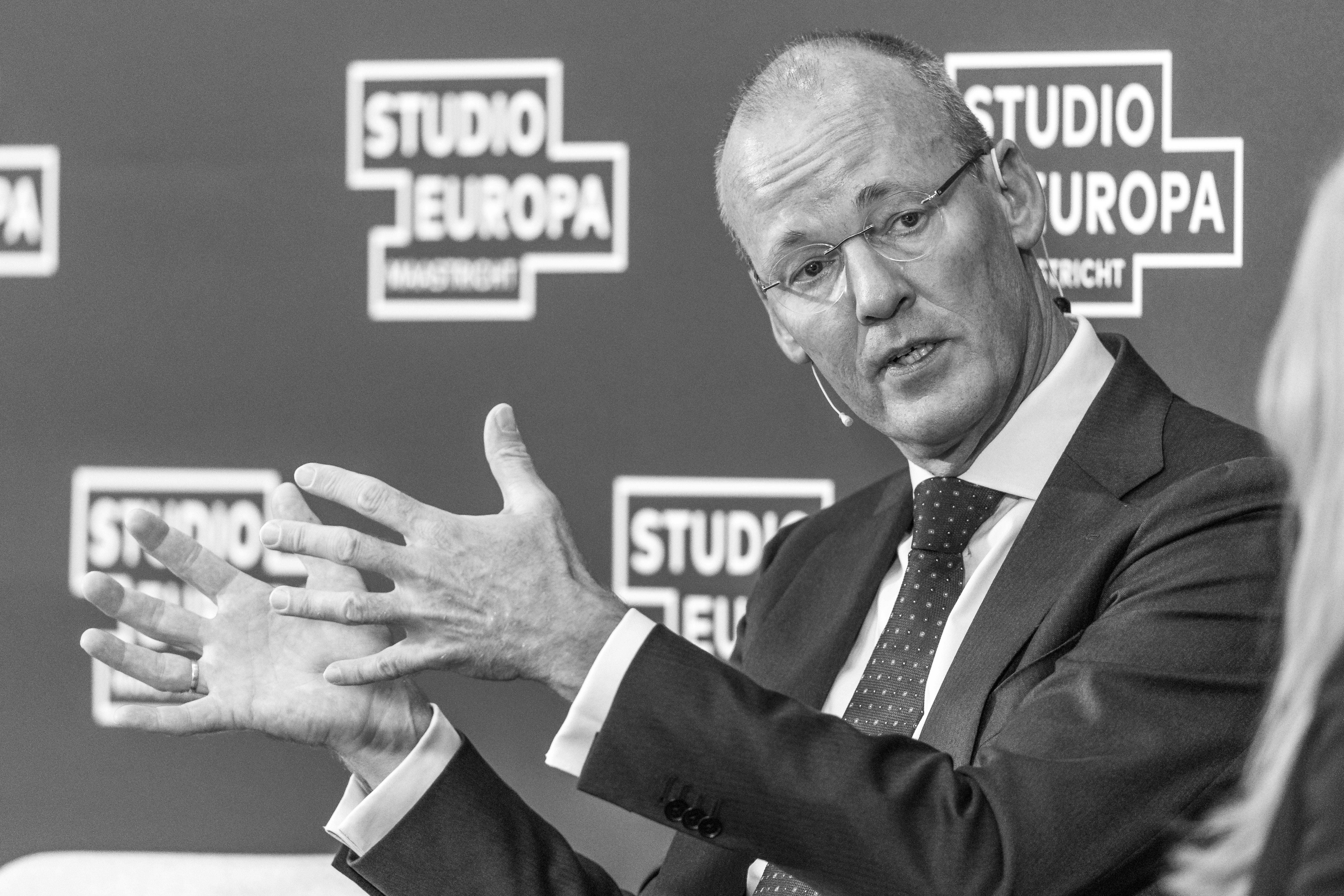
The series opens with Klaas Knot (58), a man so fit to succeed Lagarde that the president herself promoted his candidacy in an October 2025 interview. A 14-year veteran of the governing council under three presidents – Jean-Claude Trichet, Mario Draghi and Lagarde – and a government official from 2008, Knot has seen it all: a 1929-vintage global financial crisis, a string of bank failures and resolutions, sovereign bailouts and tactical yield-curve control, negative interest rates, quantitative easing, and more than five years of chronic “lowflation” followed by a pandemic- and war-induced price surge and puncture.
Born and raised in the Dutch north, Knot took his PhD in macroeconomics at Groningen.2 After a stint at the International Monetary Fund in Washington, he returned to Amsterdam and De Nederlandsche Bank (DNB) as a financial supervisor. When the crisis struck in 2008, he was sought out by the finance ministry as a liquidity specialist and quickly ascended to the department’s top role as treasurer-general. Already a fiscal conservative, treasury orthodoxy and the experience of the first year of the sovereign-debt crisis in 2010-11 reinforced Knot’s priors. Exile from the central bank was also a career advantage as DNB’s management and Nout Wellink, its outgoing president, faced a political backlash for their supervision of Icesave, DSB and ABN Amro. At 44 and untainted by the DNB’s crisis-era failings, Knot slipped through the field to succeed Wellink and become the Dutch governor on the ECB’s governing council in mid-2011.
Crisis management - learning by doing
Joining the ECB’s policymaking body in the eye of the storm of the euro area’s sovereign-debt crisis, Knot was quickly adopted by a small group of hawks grouped around Jens Weidmann, then the Deutsche Bundesbank president. Like them, he firmly believed the central bank should stand aside and let the market do its work of discovering a price for public debt that would force governments to conduct more responsible policy. In his view, euro area spreads – typically the gap between the market interest rate on most governments’ 10-year debt and Germany’s – were governments’ responsibility, not the ECB’s. To narrow the spread, governments should implement reforms to accelerate economic growth and eat away at their outstanding debt by increasing tax takes and/or cutting unproductive public spending.
However, that first year on the council was a crash-course re-education for Knot, leading to a profound rethink that decoupled him from Weidmann after Draghi’s now-legendary “whatever it takes” speech in July 2012. After Portugal was forced to accept a structural-adjustment programme in return for financial aid and Greece took a second bailout, Italian and Spanish bond yields soared. In return for reform pledges and a change of government in Rome, and against Weidmann’s will, the ECB bought €140 billion of Italian and Spanish bonds. As the crisis intensified, leading banks to cut short their risk horizons, the ECB launched three-year Longer-Term Refinancing Operations (LTROs) at a low fixed rate and saw €1-trillion take-up. Nevertheless, governments’ inability or unwillingness to take decisive steps and a string of elections drove financial contagion into the Spanish, Italian and even French banking sectors. As spring turned to summer in 2012, markets were starting to price in a break-up of the euro area as “credit risk” turned into “redenomination risk”. On 17 June, Draghi and a tight circle of policymakers and staff met for a “brainstorming session” to address this existential risk to the system.3 They mandated staff to put together a blueprint that combined policy conditionality set by the euro area’s new firewalls – the European Financial Stability Facility (EFSF) and the European Stability Mechanism (ESM) – and effectively unlimited support from the ECB. With this closely held and incomplete blueprint in his pocket, Draghi headed to a conference in London on 26 July 2012 and declared: “Within our mandate, the ECB is ready to do whatever it takes to preserve the euro. And believe me, it will be enough”.
The market impact was electric but would have been short-lived without a credible ECB purchasing programme to back it up. And quickly. This meant revealing the close-hold plan to the governing council and winning over the hawks who still felt tainted by the 2011 Italian intervention. Weidmann was a hard no, but Knot was ready to leave any irritation at being left out of the loop to one side and help design what became the Outright Monetary Transactions (OMTs) programme a month later. This was politically contentious at home in The Hague but Knot was ready to take the hit since his opinions had been shaken by the 2011-12 experience in two inter-linked ways.
First, according to macroeconomics textbooks, the repricing of public debt on secondary markets should be efficient enough to allow governments to recalibrate their budgetary policy. A slight deterioration in economic and fiscal fundamentals should translate into a slight increase in bond yields. To avoid paying more to borrow, a government would then take credible measures to increase revenues or reduce spending and yields would drop back. Equilibrium would be restored. But this isn’t what happened after the creation of the euro area. Instead, in the years before the crisis struck, spreads to Germany were tight – for example, averaging 10-30 basis points for Greece before exploding three years later to more than 500 basis points. More recently, the collapse of three French governments, the scraping through of two budgets with minimal adjustment, and the threat of a nationalist-populist president in 2027 have added just 10 basis points to the French spread. The markets’ failure to respond followed by spiralling outflows when a confidence crisis hits exerts minimal constructive market discipline on governments. Without an explicit shock-therapy mandate, no politician can act at the required speed.
Second – and this assumed more importance after 2012 – the euro area had a critical design flaw. Centralised monetary policy and decentralised public-debt issuance meant speedy political coordination was impossible. The markets’ need for speed meant the ECB was the only institution equipped to respond during a crisis of confidence. In Knot’s view, the central bank is probably “not here to close spreads”4 but, at times of crisis and to ensure that policy is transmitted with equivalent power to all parts of the monetary union, it can and should contain them. In his view, the ECB must accept a lender-of-last-resort responsibility to euro area government bond markets.5 Added to that, Draghi made him realise that, for this to work, any systemically stabilising purchasing programme had to be seen by the market as “unlimited”. The u-word is what differentiates interventions by governments from interventions by central banks. Whatever the market brings to a speculative attack, the central bank can print one euro more since its balance sheet is theoretically unlimited. A decade later, Knot brought this essential lesson to the design of the Transmission Protection Instrument (TPI).
Becoming an influencer
The education wasn’t all one way, however. Knot may have come to accept that the ECB has a unique systemic stabilising function but this can’t be money for nothing. He knew Weidmann would oppose OMTs so he needed to influence the design sufficiently to resist political claims at home that the Netherlands was abandoning Germany, its traditional monetary and fiscal partner. Once Knot had accepted the vital importance of the word “unlimited” in the programme, that meant policy conditionality had to be robust enough to anticipate the German constitutional court’s strictures. Besides, for Knot, attaching policy conditions to bond-purchasing programmes makes them more credible to markets. That way, they address crisis symptoms (bond liquidations that drive up borrowing costs) and crisis causes (snowballing debt dynamics as a government’s spending increasingly outstrips its revenues) simultaneously.
As Weidmann kept to the side lines during OMTs’ design phase, Knot negotiated the programme to his and other hawks’ satisfaction. By emerging from the Bundesbank president’s shadow, Knot began to develop a reputation as a hawk Draghi and his fellow doves could, as Margaret Thatcher famously said of the emergent Mikhail Gorbachev, “do business with”. This was never enough to make him part of the president’s in-crowd, however. Throughout his 2011-19 term, Draghi worked with tight groups of trusted senior staff, consulted with powerful bellwether policymakers – chiefly Christian Noyer then Villeroy at the BdF – and lined up dovish majorities on the governing council before key decisions were taken. Knot was rarely brought in – an experience that is sure to influence his own presidential style if he succeeds Lagarde.
Nevertheless, from the summer of 2012 onwards and especially under Lagarde’s pandemic-era presidency after 2019, Knot became a pivotal figure on the council. Two weeks before “whatever it takes”, the ECB had cut its new key rate – the deposit-facility rate (DFR) – to 0%, but it was becoming clear that policy was still too tight even after the ECB had provided banks with three-year loans at 1%. By early 2013, the council was discussing the possibility of taking the DFR negative but the negotiations were heated. Policymakers, especially those representing high-savings countries, believed negative rates were an extreme form of financial repression verging on institutionalised theft as depositors paid fees for banks (including the central bank) to hold and protect their surplus income. In the hope of taking some of the emotion out of the debate, Knot proposed the commissioning of a joint paper on the pros and cons of negative rates from his hawkish DNB and the dovish Banca d’Italia (BdI) before resuming a high-level discussion. The paper jointly submitted to the council by Knot and BdI governor Ignazio Visco helped cool the debate enough for the council to vote for a tentative first DFR cut to -0.1% in June 2014.
By the time Draghi left Frankfurt at the end of 2019, the DFR was -0.5% and Knot was convinced that negative rates had proved themselves to be a viable tool as long as commercial banks remained profitable and didn’t pass on the fee to retail depositors. They would be a go-to instrument for a President Knot if positive rates and other forms of easing are still failing to return inflation to its medium-term target. By 2020-25, not only could Knot corral hawks into more traditionally dovish positions but he could anticipate doves’ needs for trade-offs and offer them to obtain a traditionally hawkish end. This was why, even before his second term ended in June 2025, his name was increasingly heard as a successor to Lagarde in 2027.
The price is wrong - fighting “lowflation”
While he came around decisively and creatively to negative rates and using the ECB’s balance sheet to calm systemically threatening storms, Knot was and is less sold on the form quantitative easing (QE) took from 2015-19. Indeed, one of the reasons he favoured negative rates was to fend off QE: the digital creation of central bank reserves to buy fixed-income securities, mostly government bonds.
Between its launch in 2015 and its pre-Covid intended termination at the end of 2018, the ECB’s Asset Purchase Programme (APP) had accumulated securities worth €2.6 trillion. Yet, over that same period, core inflation – excluding energy and food – was just under 1% at the beginning and just over 1% at the end. Of course, the counterfactual of never-QE is unavailable but, as a catalyst to break inflation out of its 1% trap, QE was enormously costly. Before its launch and during debates over increasing monthly purchase volumes or restarting the programme in 2019, Knot expressed concern over QE’s costs and side effects.
He was right about the side effects. Misallocated capital fed significant asset-price inflation and helped ensure mediocre productivity growth. A generation of politicians, in France and Italy especially, came of age believing that the ECB would always be there to bail them out of a fiscal mess. The most egregious example of this was an interview with Jordan Bardella, the president of the Rassemblement National, with The Economist in November 2025. Well-briefed by his economic advisers, Bardella, who could well be France’s president by mid-2027, set out his plan for €100 billion of budgetary savings over five years on the understanding that the ECB “does quantitative easing, as it did 12-15 years ago” (sic).
On the effectiveness of QE, Knot has toned down his scepticism over the past decade. During the ECB’s strategy reviews in 2020-21 and 2025, he argued against fellow hawks’ wish to attach conditions to activating QE even when interest rates can go no lower (“the effective lower bound”). In his first term, he learned that, even if you’re reluctant to do something, you can’t allow that perception to get into the markets. If you do, you’ll only have to do more later. Besides, even if QE proved unimpressive at generating higher inflation before the pandemic struck, it could be a useful instrument if the ECB were again trapped in a 1% inflation regime and inflation expectations started to drift lower. Rather than do nothing, the announcement effect of QE could be made more effective in re-anchoring expectations. Instead of repeating the practice of 2015-22 and launching a programme with small but steady monthly amounts with indeterminate cut-off dates, a Knot presidency might prefer to “go big”. He was especially impressed by the Federal Reserve’s initial reaction to the Covid outbreak in March 2020. Under Jerome Powell, the Fed offered to “buy everything” – at its peak, hitting a daily amount of $100 billion – and was able to scale back quickly as the market stabilised. By bringing the acute-crisis style of intervention to addressing an inflation trap, Knot would revolutionise QE practice.
Ideally, of course, this wouldn’t be necessary. A key element of Knot’s 2011-14 epiphany – set out in his public lecture to the London School of Economics (LSE) in February 2026 – was that the original sin of monetary union was its incompleteness, manifested by uncoordinated fiscal policy. Frightened by the 2010-12 market contagion, many governments tightened budgetary policy at the same time and made the euro area’s aggregate fiscal stance hugely contractionary. That only reinforced deflationary pressures from hyper-globalisation, a lingering stock of non-performing loans, and a weak economy. For Knot, a core task for the next ECB president should be to act as a strong advocate for the whole euro area to individual finance ministries.
Tell a believable story
One of Knot’s biggest problems with QE was its justification. At its launch in 2015, the ECB’s stated intention was to provoke portfolio rebalancing as investors dropped low-yield, safe assets for the higher-risk, higher-yielding assets that finance growth. When that didn’t happen, the justification switched to anchoring long-term inflation expectations but, despite a temporary uptick, they stayed unanchored. Only later in the first year did the ECB develop a convincing argument: that, by shrinking the supply of long-duration bonds, investors chase higher-yielding assets and compress term premia – the additional return investors require for holding longer-term securities.
Draghi’s inclination to “go big” but after only a close-hold debate meant, in Knot’s view, that the ECB failed to do the joint conceptual thinking first and emerge with a robust collectively supported narrative. As former Fed chair Ben Bernanke said often, “monetary policy is 98% talk and only 2% action” so that talk has to count. For Knot, narratives are often more important than policy execution so it is crucial to unite the council around a view before taking a decision and thereby limit the communication deviations that can derail a policy. Since she found her feet as president, Lagarde has been meticulous at consensus building, obtaining buy-in from across the council and constructing policy narratives before embarking on sometimes drastic initiatives. As a Lagarde fan, Knot applied the same inclusive style to his chairmanship of the Financial Stability Board from 2021.
Unused so far but still enormously effective, OMTs and the TPI are perfect examples of narrative power. Some were surprised when Knot, a renowned hawk, was keen to design the TPI in 2022. They shouldn’t have been. As long ago as April 2021 – five months after Pfizer and BioNTech unveiled their successful Covid vaccine – Knot told Bloomberg that the ECB should soon start to consider scaling back its asset purchases. Given the intricate sequencing of the ECB’s forward guidance at the time, the DFR couldn’t rise until net purchases had stopped despite early signs that inflation could be unleashed by the vaccines. Since these purchases were considered essential in supporting the Italian bond market, Rome protested against his comments. As a result, he went quiet externally and kept his arguments in-house. By early 2022, it was obvious to everyone except the most ardent ECB dove that the DFR would need to come out of negative territory but every time market speculation picked up, so did Italian bond yields.
To allow rate hikes to begin and continue, the TPI was built and Knot was one of its strongest advocates – making the case to hawks that this was the only way they would get an uninterrupted tightening cycle. After early resistance from “Team Transitory”6 melted, a swift rate cycle got going and – as they always do – only turned contentious as it approached its end and when doves pressed for easing to begin in early 2024. Here again, Knot stepped in to find a consensus position – making a case publicly for at least 150 basis points of cuts starting in June. The market was already there but this was reassuring to impatient doves that hawks were listening and staved off arguments for more aggressive action.
This is the kind of president Knot would be – seeking to anticipate demands and getting buy-in across the council. While Lagarde is consensual to her finger tips, her definition of consensus isn’t unanimity. Consensus means that everyone accepts the inevitability of a decision by the time it’s reached. And that means giving policymakers time to exhaust debate. Under Lagarde, the council’s Wednesday meetings were brought forward to start at 08:30, followed by three rounds of discussion and a follow-up on Thursday before the press conference.
By getting the DFR to everyone’s broad calculation of neutral at 2%, Lagarde really did find a “good place”7 to sit and wait for the series of shocks that US president Donald Trump was expected to spark. Last year’s increased confidence that US tariffs on goods from the EU won’t change on a whim has evaporated since Trump threatened to hike them to 40% unless Denmark agreed to cede him Greenland. But this shock was as nothing compared to the outbreak of war between Iran and a US-Israeli alliance on 28 February 2026 and the consequent disruption to regional oil and gas production and shipping. This came when Europe’s 2026-27 gas-storage reserves were only a quarter full and euro area governments had only just weaned households off their 2022-23 energy subsidies. In a global risk-off move, energy prices rose sharply and the euro dipped against the dollar while a year of spread compression came to a halt.
Long war, short war
The ECB is in a policy bind. Typically, a central bank looks through a temporary energy supply shock, but has to be alert to the likelihood of second-round effects. This inclination will be reinforced by the experience of early 2022 when gas prices soared from €80 per megawatt-hour to a peak of €300/MWh before returning to €60/MWh by the end of the year. Then, it was immediately obvious to policymakers that Russia’s full-scale invasion of Ukraine would lead to a long-term disruption in energy supply and a sustained negative supply shock. The ECB, like the markets, assumes the Iran war will end within the Americans’ one-month timeframe although disrupted shipping and insurance cover may well persist for longer. Knot and serving policymakers have also taken note of warnings from leading LSE economist Ricardo Reis, whose research suggests that economic actors’ behaviour may have been altered by the recency of the 2022-23 inflation surge. In his view, the re-anchoring of inflation expectations around the ECB’s 2% target may be less secure than it appears. Workers who were unused to pressing for protection of their purchasing power in the years after the 2008 global financial crisis may have been changed by 2022-23. Although the labour market has loosened, the unemployment rate is still historically low around 6%. Companies still rattled by a sustained input-cost shock that began in 2022 and was increasingly absorbed by their margins may prefer to get ahead of a price tsunami this time around. If energy prices stay high, governments – including those who can’t afford it but are heading into elections in 2027 – will reintroduce price shields at the same time as they are adding to their defence budgets.
In this environment, Knot is more likely to find himself in the centre of council opinion rather than its hawkish edge. It’s far too early to gauge whether monetary policy should look through this inflation hump or lean against it. That will be determined by whether these second-round effects start to appear in the ECB’s chosen gauges of inflation expectations. Before the latest shock, Knot was comfortably sharing the “good place” with most of his ex-colleagues and struggled to see how the three most-flagged upside risks to price stability would lead to a sustained deviation of inflation from the ECB’s target. Although Germany’s fiscal stimulus is significant, it is pouring into the euro area’s widest negative output gap. Yes, tariff policy has disrupted global supply chains but the consequent inflation has been eaten by US consumers while the disinflationary effects of diverted Chinese goods are starting to be felt. The euro area savings rate could revert from 15-16% to its pre-pandemic 12-13% trend but continent-wide rearmament, erratic US policymaking, and generalised expectations of extended retirement ages and contributions all argue for higher precautionary savings.
If he does win the presidency, Knot is unlikely to chair the governing council through this latest shock. Word from Frankfurt is that Lagarde is more likely to pre-announce her departure in the summer and hand over the presidency a year early at the end of October after European leaders have chosen her successor. If it is Klaas Knot, the incoming president will not be the 44-year-old hawk who joined the council in 2011 but a centrist with a hawkish lean re-educated in the need for speed and size by Draghi and in the advantages of consensus-building by Lagarde.
Nagel heads Germany’s central bank (Deutsche Bundesbank) and Schnabel is the ECB executive board member responsible for market operations.
See my 2011 personal profile for Politico Europe (then European Voice).
The background to this episode is taken from the invaluable Monetary Policy In Times Of Crisis by Massimo Rostagno et al pp246-254. I interviewed Rostagno, who was the ECB’s Director General Monetary Policy until February 2026, for the New Books Network when the book was published in June 2021.
On 12 March 2020, only three months after taking office and as the Covid pandemic was getting underway, Lagarde told a post-council press conference: ““We will be there ... using full flexibility, but we are not here to close spreads. This is not the function or the mission of the ECB”. Six days later, the ECB launched a €750-billion Pandemic Emergency Purchase Programme (PEPP).
In his Witteveen lecture on 11 June 2021, Knot made a detailed case for “a fiscal framework that enhances coordination between member states and allows for a better alignment of monetary and fiscal policy over the entire economic cycle”.
A commonly used pet name in 2022-23 for dovish policymakers and private-sector economists who argued that the inflation generated by economic reopening after the Covid pandemic would prove transitory since it was mostly driven by short-term supply-chain disruptions and reshaped consumer demand.
After cutting the DFR to 2% in June 2025, Lagarde said: “I think we are well-positioned after that 25-basis-point rate cut, and with the rate path as it is, we are in a good place”. From then on, a “good place” became every council member’s mantra.